Saturday, September 4, 2010

google 25th Anniversary of the Buckyball

Google is celebrating buckyball's 25th anniversary by commemorating it in an interactive Google Doodle on Google's homepage.

Today’ google released its home page with interactive animated buckyball logo. It looks amazing, It mouse driven animated buckyball.  You can check out the logo in google search home page.

Have any one know how to design that type of animation? They have designed using CSS & javascript. Can any one help me to find out how to do that type of animation using CSS & javascript. It’s really amazing.


Thursday, September 2, 2010

Insomnia Increases Risk of Early Death for Men?

It's not all in your head: Insomnia has "significant physical consequences."

men-insomnia-mortality-rate_25434_600x450.jpg

Suffering from insomnia? A new finding could make you lose even more sleep.

Men with chronic insomnia who also sleep less than six hours a night have a higher risk of early death than "normal" male sleepers who get more than six hours of shut-eye, a new study suggests. (Take National Geographic magazine's sleep quiz.)

Insomnia—difficulty falling or staying asleep—is the most common sleep disorder, affecting about 30 percent of people in the U.S., according to the American Academy of Sleep Medicine. Chronic insomniacs are those who have had the disorder consistently for at least a year.

After decades of mixed findings, the new report shows that insomnia is a "serious disease with significant physical consequences, including mortality," said study leader Alexandros N. Vgontzas, director of Penn State University's Sleep Research & Treatment Center in Hershey, Pennsylvania.

Though the researchers didn't specifically study people who reported lack of sleep due to their lifestyle, Vgontzas emphasized that "losing sleep for whatever reason is bad for your health." For instance, he has published previous results showing that curtailing sleep in young adults by two hours a night for just one week is linked to inflammation that may cause cardiovascular problems.

The new study changes "how we view insomnia," said Vipin Garg, director of the Sleep Disorders Center at Trinitas Regional Medical Center in Elizabeth, New Jersey.

"It definitely is pointing attention to insomnia as more than a psychological disorder," said Garg, who was not involved in the research.

Insomnia Tracked Over Time

Study leader Vgontzas and colleagues randomly selected 741 Pennsylvania men between 20 and 100, with an average age of 50, to participate in the initial phase of the study, between 1990 and 1995.

First, the volunteers identified themselves as either insomniacs or non-insomniacs. Then they spent a night in a sleep lab, where scientists confirmed how long the subjects slept.

By combining the subjects' self reports and the lab data, the team determined that 6 percent of the men had chronic insomnia.

Between 1994 and 1997, the sleep researchers studied a thousand women with a similar age range to the men. The team found that 9 percent of the women had chronic insomnia.

By the time the scientists checked in on the subjects in 2007—14 years later for the men, 10 for the women—51.1 percent of the male chronic insomniacs who slept fewer than six hours a night had died, versus 9.1 percent of the normal male sleepers.

The findings suggest that chronic male insomniacs are four times more likely to die early—even after taking into account risk factors such as smoking, obesity, and sleep apnea, Vgontzas said.

(Read secrets of why we sleep in National Geographic magazine).

There was no such link between insomnia and premature death in women—insomniacs and healthy sleepers both had a mortality rate of just over 2 percent during the study period.

There could be two reasons for the gender discrepancy, Vgontzas said: Since the women's study was started later, there was not as much time for follow-up as for the men. It's also possible there's a "gender effect"—though insomnia is less common in men, it's generally more severe, he said.

Flaws in Insomnia Study?

There were a few weaknesses in the insomnia study's design, said Garg, of the Sleep Disorders Center.

For instance, the number of subjects in the study was small: "To give that kind of bold statement [about mortality], you want to see a bigger sample," he said.

It's also possible that during their one night in the sleep lab, some subjects experienced something called a "first-night effect." In other words, the unfamiliarity of the surroundings may have influenced their sleep patterns.

Insomnia Not a Direct Killer

The researchers did not include cause of death in their study, but study leader Vgontzas said that "no one dies directly from insomnia."

Instead, the chronic disease probably just wears on people gradually, making them more likely to succumb to other ailments.

For instance, male insomniacs in the study who were also diabetic or had high blood pressure were even more likely to die during the test period than their relatively healthy counterparts.

There's also evidence that hyperarousal—a condition that causes some people to stay awake for long periods of time—can stress the cardiovascular system, the sleep center's Garg noted.

(Related: "Secrets of Sleeping Soundly Uncovered.")

Insomniacs Born Not Made?

Causes of insomnia are still poorly understood—it may be that some people are just "born poor sleepers," Vgontzas said. But even more mysterious is how to treat the condition.

For instance, insomnia medications are mostly geared toward combating occasional sleeplessness, and psychological interventions such as cognitive behavioral therapy don't seem to work for severe insomniacs, he said.

That's why federal agencies and companies need to support the search for better treatments, and doctors need to take insomnia diagnosis more seriously, Vgontzas said.

Doctors "are used to thinking insomnia is a nuisance," he said. "They have to change their attitude about that."

The insomnia-risk study appears September 1 in the journal SLEEP.

Courtesy: National Geographic

Monday, August 30, 2010

Gmail's New Voice Call Service From Google

Gmail voice and video chat makes it easy to stay in touch with friends and family using your computer’s microphone and speakers. But until now, this required both people to be at their computers, signed into Gmail at the same time. Given that most of us don’t spend all day in front of our computers, we thought, “wouldn’t it be nice if you could call people directly on their phones?”

Starting today, you can call any phone right from Gmail.


Calls to the U.S. and Canada will be free for at least the rest of the year and calls to other countries will be billed at our very low rates. We worked hard to make these rates really cheap (see comparison table) with calls to the U.K., France, Germany, China, Japan—and many more countries—for as little as $0.02 per minute.

Dialing a phone number works just like a normal phone. Just click “Call phone” at the top of your chat list and dial a number or enter a contact’s name.

screenshot2.jpeg

We’ve been testing this feature internally and have found it to be useful in a lot of situations, ranging from making a quick call to a restaurant, to placing a call when you’re in an area with bad reception.

If you have a Google Voice phone number, calls made from Gmail will display this number as the outbound caller ID. And if you decide to, you can receive calls made to this number right inside Gmail (see instructions).

We’re rolling out this feature to U.S. based Gmail users over the next few days, so you’ll be ready to get started once “Call Phones” shows up in your chat list (you will need to install the voice and video plug-in if you haven’t already). If you’re not a U.S. based user—or if you’re using Google Apps for your school or business—then you won’t see it quite yet. We’re working on making this available more broadly—so stay tuned!

For more information, visit gmail.com/call.

Update Aug 26: This has now been rolled out to everyone in the U.S. If you don't see the feature yet, try logging out of Gmail and signing back in.


Courtesy:  Official Google Blog


Thanks & Regards,

Jayaprakash.Kandasamy


Monday, May 17, 2010

PORSCHE 911 GT2 RS STEALTH LAUNCHED IN INDIA


Now and then hypercar manufacturers slip in one of their sizzlers almost stealthily and here is one such launch that almost nobody in the Indian blogosphere have a clue about. If you’re loaded to the gills and have a fetish for fast porkers, you’ll go bonkers over what you’re about to hear.


You can now buy the Porsche 911 GT2 RS right here in India, the spy pics of which we had brought you just days ago. That is, if you can afford the gargantuan price tag of over INR 1.5 Crores. Porsche aficionados will certainly be pleased to hear that the 911 GT2 RS produces about 620 Bhp from it’s 3600cc Twin Turbo Boxer engine.


All this power will push you past the 100 kph mark in under 3.5 seconds and before you read finishing this sentence, you’ll be able to doing about 200 Ks. Yes, the Porsche 911 GT2 RS will transport you past the 200 mark in under 9.8 seconds and the top speed too is a stunning 330 Kph. Now, for those who know the rich racing heritage the GT2 moniker signifies, you can be pretty certain that plenty of other hypercar drivers would shiver at the sight of a 911 GT2 in their rear view mirrors.

Monday, April 26, 2010

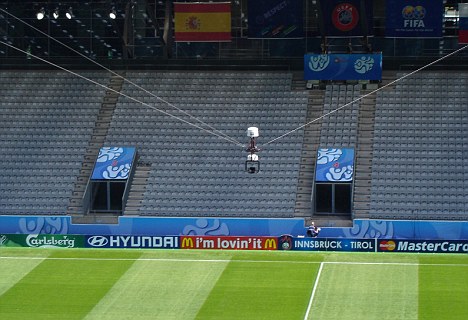
IPL goes 3D with SpiderCam

The mastermind of the spidercam®system is Jens C. Peters. He founded CCSytems Inc. in 2000 in Austria with the original aim to further investigate the innovative concept of thespidercam® and to develop a fully functional prototype. He intended to create a cable-suspension system for a camera transporting device, capable of moving not only laterally or horizontally along the ground, but also vertically, thus providing full 3D-movement while covering wide areas; applicable indoors as well as outdoors.

To reach his goal, he carried out an in depth study, made numerous calculations, plans and CAD-drawings, built models and revised them again and again. One of his major efforts was always to reach technical solutions by means of already well-known, standardised and reliable components which could be arranged in a modular manner. All developments Peters achieved are protected by international patents, and the name spidercam® is a trademark.
 
At the end of 2003 the project passed its baptism of fire: For the first time the spidercam® as known today took off, hovered and moved around freely in a large event-hall in Carinthia (Austria). In 2004 the system was employed for the first time on a television production in Austria. In the same year, J. C. Peters teamed up with the German company PMT and thespidercam® entered the German market. Right from the very beginning thespidercam® provided fantastic shots for various German broadcasters and quickly became integrated in the German media landscape.
spidercam® - the better cable camera

Moving through space without being limited by obstacles on the ground the spidercam® effortlessly and silently follows the commands of the spidercam® pilot. The free movement in space opens up completely new and unique perspectives, thus bringing your audience closer to the action than ever before. This is achieved by using the latest computer, network and drive technologies, combined with approved and high quality camera and video-components.
Basics:
Four motorised winches are positioned at each corner at the base of the covered area. By controlling the up- and unwinding of the four Kevlar-cables the camera-carrier (dolly) is able to reach any position in space. The spidercam® pilot is operating this three dimensional dolly movement; his inputs are processed by a special software, which forwards the commands to the winches. This ensures the save dolly movement at any time. The real-time communication between the winches and the control station is realised by fibre-optic cables. Another two fibre-optic cables are woven into two of the Kevlar-cables, which enables double information processing: the camera and remote head receive their respective commands, while the camera transmits its HD-Signal back to the control station. The remote head, which houses the camera, is not only responsible for the pan and tilt movement, it also controls the lens remote (focus, zoom, iris). A gyro sensor, which is installed in the dolly, stabilises the horizon. A specially trained spidercam® camera operator is responsible for all camera issues.
Set-up:
Whether TV or film productions, indoors or outdoors, small or large areas: the characteristics of a spidercam® installation are the modular design, the low weight of the components and the small rope-forces, therefore a successful set-up is possible at almost any location. With the right preparation the installation will be realisable at even the most extraordinary places - we always find the optimal solution!
Safety:
Safety is our highest priority. The spidercam® is certified by the German BGV and has been awarded the BGV C1 certification. This approval guarantees the highest level of European safety standards. In addition to the internationally approved German seal the spidercam® system is also authorized to fly over audience in accordance to the requirements of the French Bureau VERITAS.
In case of an emergency or a malfunction the security concept will stop the system immediately. This stop is composed of the deactivation of the winches and the activation of all brakes, which brings the system to a halt within milliseconds. A stop can either be initiated manually by pressing one of the "emergency stop" buttons, or automatically by one of the integrated safety protocols.
 
The most important security components:
  1. tension sensor checking the Kevlar-cables
  2. torque sensor checking the winding control unit
    mechanical check of brake functionality
    constant monitoring of the functionality of all brake contactors, motor contactors, servo amplifiers, emergency stop button and fibre optic connections
    constant monitoring of the kinematics and dolly position
Every safety-related electrical circuit exists twice. Furthermore there are two breaks in each winch, each break strong enough to handle the complete load even without electrical power. If there is a surprising loss of power all brakes will be activated automatically.

An artist's impression of how the SpiderCam looks above the pitch
 
The SpiderCam works on an aerial cable system


Monday, April 5, 2010

BSNL launches 3G services in Puducherry

PSU BSNL launched its 3G mobile services in Puducherry (earlier known as Pondicherry) falling under the Tamil Nadu circle.

The services were launched by Union Communications Minister, A Raja.

On the occasion, Mr. D.Varadarajan, CGM BSNL Tamil Nadu Circle said, “BSNL 3G Mobile service is now available to all postpaid and prepaid subscribers of Poudecherry and Karaikal city and surrounding urban areas.”

As a launch offer, BSNL is offering 3G SIM for Rs 59 with 50 free video calls and 25 MB data storage usage. After the consumption of free calls, the tariff applicable will be 30 paise per minute for local voice and video calls while STD voice and video calls will be charged 50 paise per minute.  

Thursday, March 11, 2010

Find C# application running in debug or Release mode

Message
Here is the simple solutions to check the .Net C# application is running in debug / Release mode.
 
#if(DEBUG)

    Statments with in this block will be compiled & Executed in DEBUG mode;

#else

    Statments with in this block will be compiled & Executed in Release mode;