Thursday, April 25, 2013

Northern Hemisphere observers can watch Lunar Eclipse Friday


The full moon will get a tiny bite taken out of it tomorrow as it undergoes one of the shallowest and shortest partial eclipses of this century.

While North America will be left out of the sky show, much of the Eastern Hemisphere can see Earth's shadow brush across the outer half of the moon's surface over the course of the four-hour event. 

All the stages of the eclipse will be visible across the Indian Ocean, central Asia, western Australia, Africa, and Europe.

Because only a tiny fraction of the moon's disk will dip into the darkest shadow cone, the entire partial eclipse phase will be a challenge to observe, lasting less than a half hour for viewers, Hammergren said.

"This eclipse is distinguished, or undistinguished, by being the second shortest partial eclipse of the moon in the 21st century, lasting only about 27 minutes," he said.

When is best to watch?

The most readily visible part of the eclipse will begin at 3:54 p.m. ET (00:30 AM IST Aprox), just as the moon is straight overhead for observers in the Indian Ocean.

The deepest and most interesting part of the eclipse—during which Earth's shadow will fall on less than 2 percent of the tiny sliver of the moon's disk—occurs at 4:07 p.m. ET (00:40 AM IST Aprox.) and leaves the umbra at 4:21 p.m.

The last time such a small partial lunar eclipse occurred was in 1958, and another one like it won't occur until 2034.

But don't fret: Later this year, two more partial lunar eclipses will be visible on May 25 and October 18.


Courtesy: NGC


Monday, April 8, 2013

Sony's 4K Has Arrived, Pre order starts

Inline image 1

Just a few mere months ago at CES 2013, Sony debuted its line of 4K TVs designed to bring the cinematic experience right into your living room. Well, get your living rooms ready because 4K is on the way!

Our 55″ and 65″ 4K Ultra HD TVs will be available for pre-order beginning April 21 for $4,999 and $6,999, get the scoop here.

The thing about 4K is that you need to see it in person to truly experience and understand what it is all about. A photo on the Internet or a short video clip on YouTube just doesn't do it justice. Some of you might have seen the 84'' (diag) 4K TV in select Sony Stores last fall. But if you've been dying to see what the 65″ and 55'' Class 4K Ultra HD TVs look like in real life, you're in luck.

Starting today, six Sony Store locations (see below) will be the first to feature the TVs and will be offering in-store demos of true 4K and enhanced (upscaled) video.

If you do get a chance to get a 4K demo, please share your experience! Tweet us @SonyElectronicsor @SonyStore using the hashtag #Sony4K and tell us what you thought.

Pre-orders for the 4K Ultra HD TVs begin April 21, 2013 at Sony Stores and select retailers nationwide. For more info, check out the official press release.

Courtesy: Sony Blog

Tuesday, February 26, 2013

Sony Ultrabook. How its build? Incredible Engineering


Here is a video by signal, How sony ultrabook is build in 5 mins. Really awesome.

Google lists what's new, in Jelly Bean II

Google listed out a summary of what's new in Android 4.2, Jelly Bean

This includes few new items Accessibility, Android Bean(NFC, Bluetooth,etc.,), Audio Accessories, Camera, Clock, Face Unlock, Internationalization, Lock Screen, People, Widgets, Google Now, Currents.
Android 4.2, Jelly Bean improves on the speed and simplicity of Android 4.1 and includes all new features – Photo Sphere and a completely redesigned camera app, new Gesture Typing keyboard, Google Now with all new cards, and much more.
  • Everything in Jelly Bean feels fast, fluid, and smooth. Moving between home screens and switching between apps is effortless, like turning the pages of a book.
  • Jelly Bean improves performance throughout the system, including faster orientation changes, quicker switching between recent apps, and smoother and more consistent rendering across the system through vsync and triple buffering.
  • Jelly Bean has more reactive and uniform touch responses, and makes your Android device even more responsive by boosting your device’s CPU instantly when you touch the screen, and turns it down when you don’t need it to improve battery life.
  It include few new items like People, Google Now, Currents, etc., to stay update with current trends and google.

Thanks,

Friday, February 15, 2013

Watch Asteroid Buzz Earth - 2012 DA14

Inline image 1
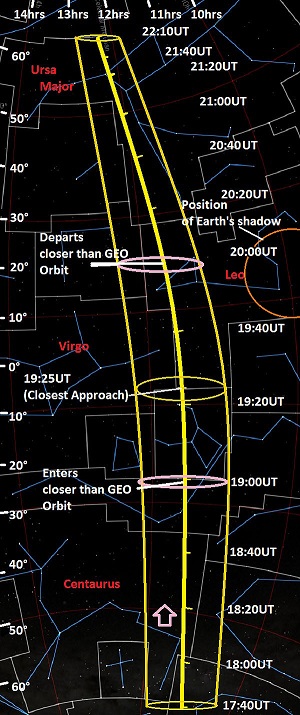
This Friday asteroid 2012 DA14 will go down in the record books as the closest approach of an object of its size since astronomers began keeping records a few decades ago.
Zipping past our planet closer than most orbiting communication and weather satellites, this office building sized chunk of rock should be visible to some lucky skywatchers in the Eastern Hemisphere.
When the asteroid is at its closest at 19:24 UTC (2:24 p.m. EST/11:24 a.m. PST) it will be flying over the eastern Indian Ocean, off Sumatra (approx. latitude: -6 deg . South / longitude: 97.5 deg.  East), according to NASA.
Unfortunately for folks in the Western Hemisphere this means it will be daylight and so predictions are that the best chances of catching a view will be from places like Africa and Asia after local nightfall on the 15th.
According to Universe Today, the best views will be from western Indonesia and Australia  when the asteroid will be crossing the overhead sky in the hours before dawn, while folks in Australia and eastern Asia may see it gliding across the heavens much like a fast-moving satellite in the low eastern sky the morning of the 16th.
Although it technically should be bright enough to be easily seen with binoculars (magnitude 7.4), a small telescope is really your best hope. Looking a lot like a faint satellite, what will make hunting down DA14 so tricky, is the fact that it's moving crazy fast across local skies- covering the moon disk's width in less than a minute.
Check out this detailed sky chart to hunt down the speedy space rock.
For those of us in the wrong hemisphere, time zone or don't have the right equipment – then check out great live-streaming web-casts of the encounter online.
NASA will have coverage using a telescope at NASA's Marshall Space Flight Center in Huntsville, Ala. from 6 p.m. to 9 p.m. ET on Friday. 
There will also be a video feed by Slooh Space Camera  from their telescopes on the Canary islands, off the west coast of Africa and in Arizona starting at 9 pm EST.
Courtesy: NGC

Wednesday, January 23, 2013

The Promise and Perils of Mining Asteroids

Inline image 1
Image Courtesy :DSI

Encouraged by new space technologies, a growing fleet of commercial rockets and the vast potential to generate riches, a group of entrepreneurs announced Tuesday that they planned to mine the thousands of near-Earth asteroids in the coming decades.
The new company, Deep Space Industries (DSI), is not the first in the field, nor is it the most well-financed. But with their ambition to become the first asteroid prospectors, and ultimately miners and manufacturers, they are aggressively going after what Mark Sonter, a member of DSI's board of directors, called "the main resource opportunity of the 21st century."
Prospecting using miniaturized "cubesat" probes the size of a laptop will begin by 2015, company executives announced. They plan to return collections of asteroid samples to Earth not long after.
"Using low cost technologies, and combining the legacy of [the United States'] space program with the innovation of today's young high tech geniuses, we will do things that would have been impossible just a few years ago," said Rick Tumlinson, company chairman and a longtime visionary and organizer in the world of commercial space [not sure what commercial space means].
"We sit in a sea of resources so infinite they're impossible to describe," Tumlinson said.
Added Value
There are some 9,000 asteroids described as "near-Earth," and they contain several classes of resources that entrepreneurs are now eyeing as economically valuable.
Elements such as gold and platinum can be found on some asteroids. But water, silicon, nickel, and iron are the elements expected to become central to a space "economy" should it ever develop.
Water can be "mined" for its hydrogen (a fuel) and oxygen (needed for humans in space), while silicon can be used for solar power systems, and the ubiquitous nickel and iron for potential space manufacturing. 
Sonter, an Australian mining consultant and asteroid specialist, said that 700 to 800 near-Earth asteroids are easier to reach and land on than the moon.
DSI's prospecting spacecraft will be called "FireFlies," a reference to the popular science fiction television series of the same name. The FireFlies will hitchhike on rockets carrying up communication satellites or scientific instruments, but they will be designed so that they also have their own propulsion systems. The larger mining spacecraft to follow have been named "DragonFlies."
Courtesy: NGC

with regards,
Jayaprakash.K

Wednesday, January 2, 2013

Happy Birthday: The Internet is 30 years old now

The Internet which has transformed the lives of billions of people across the world, turned 30 on Tuesday. The computer network officially began its technological revolution when it fully substituted previous networking systems on 1 January, 1983.


Known as "flag day", it was the first time the US Department of Defence (DoD)-commissioned Arpanet network fully switched to use of the Internet protocol suite (IPS) communications system.

Using data "packet-switching", the new method of linking computers paved the way for the arrival of the World Wide Web.

"I don't think that anybody making that switch on the day would have realised the importance of what they were doing," the Daily Telegraph quoted Chris Edwards, an electronics correspondent for Engineering and Technology magazine, as saying.

"But without it the internet and the World Wide Web as we know them could not have happened."

Commenting on the historic event's impact on the world, Edwards said: "The internet means there is nowhere and no one in the world you can't reach easily and cheaply."

Based on designs by Welsh scientist Donald Davies, the Arpanet network began as a military project in the late 1960s.

It was developed at prestigious American universities and research laboratories, such as the University of California, Los Angeles (UCLA) and the Stanford Research Institute.

Starting in 1973, work on the powerful and flexible IPS and Transmission Control Protocol (TCP) technology which would change mass communications got under way.

The new systems were designed to replace the more vulnerable Network Control Program (NCP) used previously, making sure the network was not exposed to a single point of failure.

This meant a single attack could not bring it down, making it safer and more reliable, the report said.

By January 1 1983, the substitution of the older system for the new Internet protocol had been completed and the Internet was born.

British computer scientist Tim Berners-Lee was then able to use it to host the system of interlinkd hypertext documents he invented in 1989, known as the World Wide Web.

Courtesy: Fisrtpost